Showing posts with label Trackplan. Show all posts

Monday, December 14, 2020

The Eastborough Industrial

It's been a long slow process, but I've narrowed in on what I really want out of this layout and have finally worked out a plan which I think satisfies at least the top criteria.

(click to enlarge)

The layout represents the end of a freelanced industrial track - one of those tracks that branches off the main and winds a couple miles or so serving a few industries that seem to be more common than you might at first think.  I've selected the industries to give me a mix of car types, car flows, and switching.  The industries are all cribbed from real prototype industries in eastern Massachusetts, with varying degrees of modeler's license.

Eastborough

Eastborough is not a real town in Massachusetts, but it could be.  There is a cluster of -borough's that includes Marlborough, Northborough, Westborough, and Southborough, but no Eastborough.  So, the name Eastborough gives those familiar with the area and idea of where it's imagined to be - somewhere near where routes 495 and 95 cross.  The CSX mainline (formerly Boston & Albany) runs through Westborough, and the Fitchburg branch runs through Southborough, Marlborough, and Northborough.  The Grafton & Upton shortline is nearby.

What Railroad

You'll notice I haven't been specific about what railroad serves the industrial track.  I don't view that as particularly important, so I haven't decided yet.  I have a soft spot for switchers like MP15s, but a GP40-2 or GP38-2 is nice too.  If the industrial track is served by a shortline or terminal railroad any of those are possibilities.  If it's CSX that serves the industrial track, power will be a GP40-2 (CSX's power of choice on locals).  CSX sold all it's MP15s a few years ago - some of them ended up on the Grafton & Upton.

Operation

At the start of a session, a train is made up in staging with the engine on the front end, ready to pull the train onto the layout.  Train length can be anywhere from just a couple cars to a couple dozen cars, although somewhere around a dozen will probably be typical.  The runaround that should be mostly adequate, but which will require a couple runaround moves to deal with the largest sessions.

There are no tricks or switching puzzles, just some decent sized industries with a variety of needs.  I haven't decided on the mechanics of car routing and the form of "paperwork" to document it yet.  The mechanics may be software, or manual.  Whatever the mechanics, I'd like the resultant "paperwork" to be able to take one of several forms depending on who is going to be doing the actual switching and their skill level and preferences - any one of waybills, switch lists, PICL lists, or even tab on car.

Trans Plastics

The biggest industry in terms of car count is Trans Plastics, lifted straight off my N scale Palmer Industrial Park plan, in turn lifted pretty much straight from the prototype Palmer Industrial Park.  The prototype industry went out of business over 10 years ago unfortunately - smaller plastic transload operations seem to have difficulty.  But I like the big plastic pellet hoppers and the car flow pattern and switching that creates so I'm modeling it anyway.  Normally the industry will be mostly full, but like the prototype will only receive and release 1-4 cars a week.  Cars are emptied apparently randomly since they get emptied by demand for what grade of plastic they contain.  Spots are stuffed in wherever they fit, placement is not important.

National Lumber

National Lumber is cribbed from National Lumber on "The Chocolate" - an industrial park spur in Mansfield, MA.  I like the large warehouse with the track only along half of it, and the two door spots on the warehouse, and the fact that the centerbeam unloading area is past the warehouse.  I "improved" on reality to have 3 centerbeam spots instead of just one.  There will be times when centerbeams are cycled through at a good clip, and times when there's no center beams and only a single boxcar at the warehouse.  Cars will almost always be unloaded before the next switch, so there will rarely be respots.

Tighe

There are a three rail served Tighe warehouses in eastern Massachusetts - Mansfield, Winchester, and Woburn.  I plan on cribbing the building appearance from the Mansfield warehouse, which has 9 doors spaced on 77 foot centers.  I'll keep the spacing, but trim it to 8 spots.  There are rain diverters on the roof, which makes it easy to measure the spacing on a satellite photo, and which will make it easy to line the boxcar doors up with the warehouse doors on the model.  This warehouse will take more switching moves per car to get the job done than the other industries.  Each car will be billed to a specific door spot.  Not all cars will be unloaded by the next session, so there will be some re-spots.

Broco Oil

Broco oil is inspired by the prototype Broco Oil in Haverhill MA which just started receiving biodiesel heating oil about a year ago and has been ramping up considerably, adding track, a trackmobile, new storage tanks, etc.  My representation of it will need to make do with a single shorter track, but it's long enough to give a good feel of an active business.  Since they only receive only B99.9 biodiesel tank cars are simply unloaded sequentially.  The empties will always be at one end of the track, the respots (if any) at the other.  Broco Oil will be easy to switch, but should allow for moving nice long cuts of tank cars in the process.  Biodiesel tank cars are hazardous, with a 1202 placard.

Broco also advertises transloading services.  From what I can tell they've only had one customer for that so far, transloaded a few gondolas of rebar to flatbed trucks.  That will allow for a very occasional bit of variety from the usual.


Sunday, December 6, 2020

NYS&W New York Mills Industrial

I should say up front that this is not the model railroad I am going to build.  I'll explain why below.  But it was a strong contender and I came close to building it, so I think it's worth writing about.

When I discovered the New York, Susquehanna, and Western's Utica area industries earlier this year I became pretty interested.  A number of relatively small industries, mostly on a separate industrial track with a fairly interesting track arrangement.  I wrote up some information on the prototype on a separate page on this blog here.

There is a very photogenic crossing tender's tower, street running, and a brewery spur with a switch in the middle of the street on the Utica branch mainline.  But the part that intrigues me more is the New York Mills industrial track (technically it's actually two tracks - the New Hartford industrial track, and the New York Mills industrial track).  The prototype is a deceptively simple switching puzzle.  I decided to focus on the industrial tracks for their operating interest, and ignore the street running section.

Things that make the combination of the New Hartford and New York Mills industrial tracks an interesting switching problem:

  • A relatively short runaround at the very start of the industrial track.
  • A branch to a switchback leading to one of the industries (Oneida Warehouse).
  • An industry literally on the end of the line - no switch, that's it.
See the the prototype page for maps, more details on industries, and prototype vides.

The first attempt


Even though it's a relatively small industrial track, there is still a total of almost 6 miles of track.  So the question is, how to squeeze that into the available space.  Here's my first reasonable attempt.

(Click to enlarge)

The New Hartford switchback and Oneida Warehouse are left off entirely.  The remaining four industries are compressed and slide considerably closer together than on the prototype, but that's inevitable if you're trying to squeeze 3 to 4 miles of prototype track onto a shelf well under a scale mile long.  The industries are all in the right relative positions on the prototypical side of the track.  A staging area could be added on the other side of the bulkhead door at the bottom, or the train could just be sitting on French Rd runaround at the start of the session with the engine in the lead.  The Di Highway section would be a fold down section to allow freer use of the basement for other non-railroad purposes.

Things that bothered me about this plan was having an industry on a fold down section, a bit more industry compression than I was hoping for, and no chance of adding the New Hartford section.

The second attempt

The breakthrough came with the realization that if I mirror imaged the industries I could solve all those problems.

(Click to enlarge)

In this plan, the drop down section is just the lead off the Utica branch mainline.  The industries are a bit less compressed (although mirror imaged), and there's a bit more space between them.  And there is the option of tunneling through the wall to put the New Hartford section in the next room, with the switchback (which adds an element of intrigue when you're at the runaround out of sight of it trying to get the cars on the right end of the engine).  There is an additional drop down section across the bulkhead door to get to Di Highway, but that wouldn't need to be use much and it's only scenery, so no problem there.

So why not build it?

I spent a month or so wanting to build this track plan but feeling unconvinced that it was the right one for me.  Finally I took a step back and thought about what industrial switching I like watching on the prototype most.  Any prototype switching is interesting to watch, but what really ticks both the industrial interest and gut feel of railroading boxes for me is not one or two car industries, it's bigger industries.  Industries where a full spot is half a dozen cars or more.

So that's why I'm not going to build this layout.  It would be a nice layout I would enjoy operating on, but it's not quite exactly what I want for a layout.

Monday, September 5, 2011

Transfering the Plan

On both my new N scale Palmer Industrial Park and my older O scale No-Name Industrial Park I drew the trackplan in a cad program (Ashlar Vellum, for reasons I won't bore you with here).  The cad drawing has very accurate turnout locations with point, frog, and center lines marked, and also easements.  The challenge then becomes getting the drawing onto the layout in a form that helps you lay track.  I described the process of getting the full size printout in Mocking up the Palmer Industrial Park.

Once you've got the full size plan taped down to the layout (and in the case of foam, if you're going to paint the foam paint it before you get to this stage) you can transfer the plan from the paper to the layout.  I use a pounce wheel, which is a sharp pointy wheel in a handle.  You can get cheap ones at fabric stores, but they don't have the sharpness necessary to do a good job.  I bought the 3-piece pounce wheel set from Micro-Mark, and I mostly use the largest of the three wheels.

Using the pounce wheel is simple.  Try it out on a scrap with however many paper thicknesses you have to see how much pressure you need to get a good line of dents.  It needs a lot more pressure on plywood than it does on foam.

Using the pounce wheel
At intervals while you're doing the pounce wheeling, take a break (your hand will need it anyway), and very carefully peek under the paper without moving it to make sure you're getting a good line of dents - not too deep, and not too faint.

Once your done, make sure you've got decent lines of dents everywhere.  For laying track, you want the line to be clearly visible between ties and through a thin layer of glue, so you need to go over the dents with a pencil or permanent marker.  If there are places where the dents get a bit faint (it happens), shining a flashlight along the line will bring them out.

A flashlight makes tracing dents easy
A bit of care and patience, and the cad drawing is transferred very accurately to the roadbed.

I've done all the pounce wheeling on the Palmer Industrial Park, but I haven't yet done all the tracing.  The printed plan is now serving as a drop cloth to keep backdrop and fascia paint off the foam, after which it will be discarded and I'll finish the tracing.

I should note that an alternate approach I've seen used on the North Shore Model Railroad club layout's newer areas is to simply glue the printed track plan to the plywood, and glue the roadbed and track to the plan.

Tuesday, May 10, 2011

No-Name Evolution

The No-Name Industrial Park track plan and indeed the layout itself has gone through a series of identity changes, geographical relocations, time periods, and just about any other change you can think of.  I'll describe a few of the more interesting points along the way.

I started off knowing I wanted some focus on industrial switching, but I was also thought I wanted some continuous running.  I had originally been thinking about modelling the 50s, the default time period of model railroading.  Once I realized how big an O scale turntable was going to be I decided steam power was not a wise use of my space.  I slid the time period ahead to the late 60s and early 70s.  The location was set in the area of western New York where I grew up.  So my first serious O scale plans were called the Elmira Industrial, placed in Elmira, NY circa 1970.

The Elmira Industrial, an early version
I managed to squeeze in a double track mainline, some staging, a small yard, a couple industries in Elmira itself, and an industrial branch.  At the end of the industrial branch was Thatcher Glass, a large glass bottle manufacturer.  And near the end was an interchange with the PRR.  Even at the time I drew the plan I knew better than to have a duck under - I just don't like them.  So I thought perhaps a drop leaf or something might do.  But that compromise, combined with the short length of the yard tracks, staging, and the over crowding of the industrial area made me have second thoughts.  When I started thinking about the tiny yard and how many cars it would have to handle in how many different blocks I realized the plan was out of balance with itself.

The next iteration of the plan did away with the duck under and therefore the mainline as well.  It still had staging though.  The general idea was that the mainline (which actually would exist in dummy form on the front edge of the layout near the yard throat) was implied, and trains would pick up and set out blocks in the yard.  In reality that meant and engine shoving a cut of cars in from a staging track and returning with a different block.  There was staging for east and west bound EL traffic (the railroad being modelled was the Erie Lackawanna), Lehigh Valley (which ran up from Sayre PA through Elmira to Horseheads, interchanging with the EL in Elmira), and a couple Pennsylvania tracks (PRR had trackage rights on the EL through Elmira).

The Elmira Industrial, a later version
The larger yard in both length and breadth would easily accommodate handling the inbound blocks, and classifying for various industries and the 4 different outbound blocks.  Thatcher Glass still occupied what you will recognize as the peninsula devoted to the N scale Palmer Industrial Park now, but it's based on a slightly earlier configuration of the prototype before the newer set of warehouses got built.

At that point construction got seriously under way, and the bottom part of the plan along the wall was built, plus a little bit up the left and right side walls.  I hand laid code 125 rail on wood ties, using Old Pullman turnout kits.  It was exciting - nothing beats the thrill of the first train run on hand laid track.

First train runs!
After the initial euphoria wore off I started to notice a few hiccups with the Old Pullman turnout kits and in the process of tinkering with them to improve them I learned more about turnouts and what to keep an eye out for.  Some inspection revealed that the one curved turnout kit I had purchased would require so much work to get the closure rails to properly line up with the frog, etc. that it might just be easier to start from scratch.  (I believe I may have ordered my turnouts at a bad time in Old Pullmans transition between owners, I would not assume my experience from some years back is any indication of their current product which I have heard good things about.)  If you look at the trackplan closely you'll notice that there are 6 or 7 curved turnouts in the yard throat area that are critical.  Any flaws in this area would make the layout a nightmare to operate.  And you'll notice that there are a lot of turnouts in general.  Doubts about my ability to get this layout operational began to set in.

Around this time two other things changed.  I started doing a lot more rail fanning, and began to get enamored with present day railroading.  (I don't use the term "modern", because various people use "modern" to refer to anything from a 1950 F unit to a 2010 genset.)  And Atlas starting making good quality O scale turnouts.  I started thinking about how to re-arrange the plan to use Atlas O turnouts.  Without the curved turnouts in the yard throat, the yard couldn't be nearly big enough to support the general operating scheme.  Major changes seemed to be in order.

The Corning Industrial
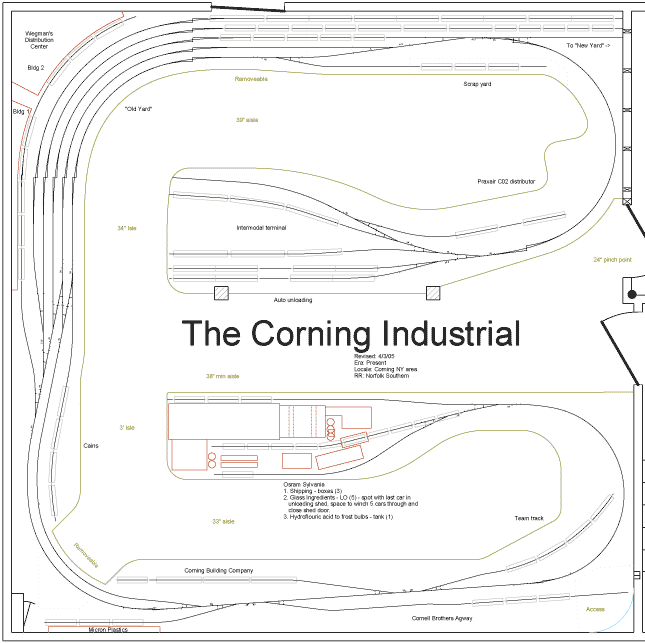
The result was the Corning Industrial plan.  Corning is about 10 miles west of Elmira in real life, and the former EL has gone through the Conrail stage and is now the Norfolk Southern.  This time the mainline was not even hinted at on layout, it was "over there" a the other end of the yard just past the top right corner of the room.  There was also no staging.  The assumption is that through trains, one eastbound and one westbound, would pick up outbound blocks and set out inbound blocks "overnight" - in other words between operating sessions.  At the start of an operating session two of the yard tracks would have the two inbound blocks on them.  A third track allowed for some storage.  The remaining two tracks were the through track and the runaround.  Not many tracks in number, but all pretty decently long, and I figured there would be enough space to sort things out without getting too crowded.  The parts of the layout with track already laid stayed untouched, with one exception - the second track and industry in the middle of the wall got removed in favor of a single larger industry.  The one remnant of the original plan lingers to this day in the No-Name Industrial - the jog in the middle of the track.  There's still a glass plant on the peninsula, but this time it's based on the Osram Sylvania plant in Wellsboro, PA.  The area formerly occupied by the yard was now planned to be an intermodal area.  Two tracks for auto racks, two tracks for intermodal flats.

Norfolk Southern uses big power for everything, and with the length of cuts I expected to be dealing with to sort out the yard it seemed like a two unit consist would not only be prototypical, but necessary.  I bought two Atlas O B40-8s.  A couple sample intermodal flats, more articulated auto racks than I care to admit, and I figured I was in good shape.  I built the left and top wall parts of the plan, and got started on the curve around into the intermodal area.  Things went considerably faster with flextrack and ready to run turnouts.

Two thing went wrong.  First, although it seems like there is enough track to handle everything, once I started actually moving cars around I started to realize that while there was enough track for everything to be on without over crowding at any given point in time, there wasn't necessarily a way to move a cut from point A to point B without either pulling long cars through the tightest curve on the railroad (36" radius going to the glass plant), or breaking the cut in half and doubling it through the crossover between the runaround and the through track.  My long yard tracks which had seemed so nice and spacious on the plan were turnout out to have moved the throat so far around that I didn't have enough lead!  Changes were called for.

The second thing that went wrong is the B40-8s themselves.  My first Atlas O engine was an SW-8 which runs like a dream.  (I don't really count the little plymouth diesel in the above photo - an ancient Atlas unit I picked up at a white elephant table.)  Very smooth starts and stops, good smooth slow speed running.  The B40-8s on the other hand simply would not sustain any speed between 0 and 3 or 4 smph with a standard decoder - you had to either be starting or stopping.  Once you got past the initial jerk into motion they ran pretty smoothly.  But since my whole operation is switching, starting and stopping is very important.  I could not make them run what I considered to be acceptably smoothly while starting and stopping slowly.  I got reasonably close with two zimo MX69S back-emf decoders, one for each of the two motors in each unit.  There were still subtle but irritating jerky motions though.  I bought an SD40 when they came out and were reported to have fixed the running problems of the B40-8s, however I found it still suffered from the same fundamental problems.

The Corning Industrial was now teetering on brink of survival, and the thing that pushed it over the edge was the arrival of the Atlas MP15 - a new switcher which had all of the same operational qualities as the original SW8 in a more modern and highly detailed package.  The Corning Industrial got a major mission change - sparser, fewer cars to be handled per op session, and it would be considered to be the end of an industrial branch.

The Corning Industrial last gasp
I did some mockups, pulled up a couple tracks, and played around with the idea for a while.  But in the end I came to the conclusion that a large part of my problem all along had been over reaching - planning something larger than I could reasonably build and maintain, and cram too much operation onto it.  Drastic measures seemed to be in order. I decided to keep just the left and bottom sides of the plan, and rip out everything else.  Well, except for the peninsula which I decided to leave in place in case I ended up wanting to put some staging on it.  It wasn't until later that I got the idea of building an N scale layout on it.

The No-Name Industrial Park
The power tools came out, large chunks of benchwork were removed, lots of homabed glued into nicely easemented curves around the top left corner was chiseled off and construction got under way on what I hope is the final reconfiguration.  I also had a lot of rolling stock and a few engines to unload, which turns out to be a lot harder than you would think.  I've got a lot of stuff on consignment at a hobby shop, I donated some stuff to a local club, and I gave some stuff to a couple friends who used it to set up their own modular O scale switching layout. It's apparently relatively easy to sell used HO scale equipment, and N scale equipment is so small you can store a whole railroad's worth in a small drawer.  But with O scale, it was taking LOTS of space in the basement, and let me tell you trying to fit 12 O scale articulated auto rack boxes into the back of a car to take somewhere to sell is NOT easy, and you won't get anything else in that trip.  Just something to think about if you ever find yourself in the mood to buy lots of equipment up for a planned O scale railroad.

I'm pretty happy with the end result.  Operations are interesting even though I don't have the full complement of boxcars necessary for Northeast Container yet (I'm being cautious about buying more than I need, a few at a time until it seems like enough is the plan).  An op session takes somewhere between 45 minutes and 2 hours, depending on what needs to be done.  The layout feels much less crowded, which is nice too.  The smaller size also makes a little more likely that some day I might actually get some scenery done.

I've come to realize that although I really enjoy operation on some larger layouts with large yards and long mainlines, it's not what I want for my own layout.  I'd like to think I've arrived at a good lasting plan, but of course there is always that cynical little thought that pops out saying "yeah, right".  Time will tell one way or the other.

Tuesday, May 3, 2011

The Palmer Industrial Park

I'm in the early stages of building an N scale layout representing the Palmer Industrial Park, served by the New England Central railroad.  Why a separate second layout?  I got to thinking about it because I found myself wanting to model some larger industries than could be fit in my space in O scale.  I also wanted to keep the O scale switching layout, which meant the remaining available space was too small to model larger industries in HO scale.  Hence the choice of N scale on a second layout.

In addition to modeling larger industries, I also wanted to get more of a prototypical feel to the track arrangement.  I used # 5 turnouts on my O scale layout - unrealistically sharp.  After spending some time with satellite photos measuring angles of switches on industrial track I was interested in, I came to the conclusion that # 10 switches were just about right.  I verified this with a tape measure on a field trip to a location with a switch in a parking lot I could measure the frog taper on.

In real life the Palmer Industrial Park is in Bondsville, MA, just north of Three Rivers and Palmer.  It's worked by a local out of the NECR yard at Palmer.  I'll write a post about the prototype at some point, but for now suffice it to say that I couldn't squeeze in an exact replica of the park.  So I took all the interesting pieces, shuffled them around to fit, and used a little imagination.

Trackplan for the Palmer Industrial Park
The peninsula is 16 feet long, and 3 feet wide at the left end.  It's slightly odd shape at the right (wall) end lets it fit between the door and the O scale switching layout.
Edit 1/18/2015: I realize I neglected to include a few details here.  All turnouts are #10. The big curve around the end is 16" radius, the minimum radius everywhere else is 24", and most curves are much bigger radius than that.  The easement offset is 0.25".  Track and switches are Atlas code 55.
The park has a long lead which comes in from the NECR main at Barrett's.  The lead is the track next to the aisle marked Lead on the track plan above.  The runaround and it's tail track head off back to the right and disappear into the weeds - the presumption is there used to be more industry over there but it's now abandoned.  The runaround holds 20 50 foot N scale cars.  One option I considered during planning was to put the runaround on the lead and eliminate the "extra" track.  However with the potential for 15-25 inbound cars and 15-25 outbound cars in a session the additional space will come in very handy.

The only industry on the lead side of the peninsula is Quaboag Reload (pronounced "kway-bog").  Quaboag is patterned after a combination of the now defunct Quaboag Transfer that was a large customer in the real Palmer Industrial Park, and Wildwood Reload - an industry on the Massachusetts Central RR in South Barre, MA.  Pretty much anything that needs to move between rail and truck can show up here.  Common loads will be lumber on centerbeams, wood pellets, paper rolls, and building materials in box cars, pipe in gondolas, sheet steel in coil cars, etc.  The first warehouse on the lead is completely enclosed, the second is open at the track end.  The large areas in between and at the end of the track are for unloading lumber, pipe, etc. that don't need indoor storage.

The industry just around the corner is initially going to be Cains - an N scale version of the same industry I have on my O scale layout.  What I really want to put there is another industry from the real Palmer Industrial Park - American Dry Ice.  However there are no N scale CO2 cars available at the moment.  Atlas makes some nice vegetable oil funnel flow tanks, so it's Cains for now, and if/when CO2 cars appear I'll replace Cains with American Dry Ice.

The next industry is Trans Plastics.  In the real Palmer Industrial Park this industry is at the end of the park track, but it seems to fit better when I've put it in my available space.  Trans Plastics has space for around 20 covered hoppers loaded with plastic pellets.  As with the real one when it was still in business, the industry will be close to full most of the time, but only release and receive 2-4 cars a session.  Since there are a lot of different grades of plastic in the various cars that get used up as needed, the cars released may be scattered around, so this industry will be interesting to switch.

The final industry is Maple Leaf Distribution.  In real life Maple Leaf now has 3 pairs of tracks serving 18 doors.  Before their addition of a few years ago, it was 1 pair of tracks serving 10 doors.  I plan to compress reality a bit to make the "original" building have 7 spots spaced for 50 foot cars (like the original 10 on the real thing), and the "new" building on the same pair of tracks have 3 spots for 60 foot cars (like the new spots on the real thing).  Maple Leaf receives lots of paper rolls and a number of other commodities in box cars and ships them out by truck.  They also receive recycled paper by truck and ship it out by box car.  They generally assign cars to doors to minimize movement through the warehouse.  There may also be respots (a car not completely unloaded needs to be moved to pull/spot another car, then returned to where it was).  A car that was on the outside track and not completely unloaded may need to be respotted at the same door on the inside track.  The combination of specific door assignments, respots, and the two tracks should make for some very interesting switching.

The main park track continues past Maple Leaf and fades into the weeds at the wall.  The almost 20 car lengths between the Maple Leaf switch and the wall will provide needed space for sorting cars and stashing outbound cars out of the way.

The current state of the railroad is bare benchwork, with a full size trackplan tapped to it (more on that later).  The benchwork is actually a re-purposed section of what was originally planned to be a larger O scale layout.

Monday, April 25, 2011

The No-Name Industrial Park

The No-Name Industrial Park is my O scale switching layout.  It represents a small industrial park somewhere in eastern/central Massachusetts.  I've had so many different ideas of what I want to call it over the past year that I've decided to just ignore the naming problem for now.  Therefore for the time being the layout is known as the No-Name Industrial Park.  The park is operated by a switching service - also unnamed as of yet.  The park lead serves as an interchange track with the nearby railroad - also unspecified (but which will be either CSX or Pan Am Southern).

Trackplan for the No-Name Industrial Park

The room is almost exactly 21 feet on each side.  For perspective, that's 1008 feet in O scale.

The connection to the outside world is in the lower right, where the tightest curve on the railroad (36" radius) curves out into the aisle where it says "interchange".  Following the main track from there, the first switch you come to is a 3 or 4 car storage track for Northeast Container.  Next is the switch for Midstate Recovery Systems, a construction and demolition debris recycling business.  Next is the switch for Northeast Container itself, followed by another short storage track.  Around the lower left corner is the runaround, which can hold 9 or 10 cars.  The runaround is a slightly more forgiving 44/48" radius.  Continuing up the left wall, the next switch is for Tighe Warehouse, and then a transload track.  The final switch is for Cains Foods.

I got the idea for a switching service operating the park from SMS Rail Lines, a company that operates several industrial parks in New York, New Jersey, and Pennsylvania.  It's a fascinating operation - you can spend quite a bit of time poking around their web site and studying google/bing maps satellite and aerial photos of the parks they serve.

Power for the park switching service is an MP-15 purchased second hand from CSX and given a patch paint job.  Or at least that's the plan - currently the Atlas O MP-15 sports factory fresh CSX paint.  The MP-15 is generally kept up near the Cains switch, where there's a small trailer office.  The switching service keeps someone on hand to respond to customer requests whenever needed.  So an operating session might be as simple as pulling an empty/load from a customer to replace it with a fresh car from storage, as complex as finding a dozen inbound cars on the interchange track that need to be shuffled into position, or anywhere in between.

Northeast Container is based on the Temple-Inland plant in Biglerville, PA served by the Gettysburg Northern RR.  The plant makes boxes.  It receives boxcars of pulpboard and an occasional hopper car of starch.  Some of the empty box cars get re-spotted at the outside dock to be loaded with scrap cardboard.  Jack Hill describes it here on his blog.  You can see it in the satellite view on google maps.  As soon as I read Jack's description of the operation at the plant, I knew it would be much more interesting than the feed mill I had originally put in that spot on the layout.  I will be using a motley collection of 50 foot boxcars, plus an as-yet un-acquired starch car to serve this industry.

Midstate Recovery Systems recycles construction and demolition debris.  This is a real industry in Portland, Connecticut served by the Providence & Worcester Railroad.  You can see it here on google maps.  This industry caught my eye when I saw this photo of it on NERAIL.  It's a relatively small building with a track going through one end of it - only two cars fit inside.  Debris arrives via truck and is dumped in the building.  It's then loaded into railcars.  If you're an O scale person used to not being able to get the type of car you need for an industry, you will probably have noticed that the cars in the photo are coalveyors (some with side extensions) - a car Atlas actually makes!  On the No-Name Industrial Park the building is positioned so the truck dumping portion of it will be implied by the on layout portion of the building missing the aisle side wall.  The building is carefully position to make it easy to see the clearance point for the runaround on one side, and to easily reach the caboose ground throws for the three nearby switches.  I sincerely hope my model doesn't collapse under the weight of a record snowfall as the prototype did this January - see photo.

The Tighe Warehouse is based loosely the Tighe Logistics Group warehouse in Mansfield, MA.  There are other Tighe facilities in the area.  The Mansfield one is at the lead end of an industrial park called "the chocolate" by the railroad for historical reasons, it's served by a CSX local.  You can see it here on google maps.  On my layout most of what this warehouse receives will arrive in NS 60 foot Berwick hi-cubes (Atlas), plus a few FBOX 50 foot hi-cubes (MTH).

The transload track was inspired by J.P Noonan operations I've seen in Mansfield and Leominster, MA.  The track serves local industries that don't have rail service of their own.  There will almost always be several plastic pellet cars here, and often a hopper or two of soda ash for a nearby water treatment plant.  The plastic pellet cars are old Weaver cars - good enough to get the point across but that's about it.  The soda ash cars are a couple MTH hoppers.

Cains is based pretty closely on the Cains plant in Ayer, MA.  You can see it here on google maps.  The plant receives tank cars of vegetable oil.  There are 4 unloading spots inside the chain link fence on their siding, which is served by Pan Am Southern.  The piping leads to a tiny cement building next to the track, from which it apparently proceeds underground to the main building.  On my layout the main building is presumed to be in the aisle, so all I need to model is the little cement block building and a suggestive patch of asphalt in the parking lot (see the satellite photo).  I'll be using Weaver 50' tank cars for this industry even though they aren't right - unfortunately there doesn't seem to be a decent funnel flow veg oil tank in O scale.

The current state of the railroad is ugly but functional.  I'll post some photos sometime soon.  And I'll also post something about that blank peninsula sticking out into the room from the right wall.